
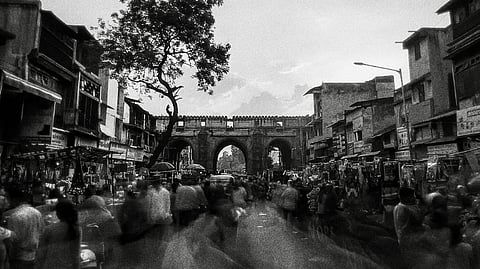
Manek Chowk in Ahmedabad has a story that goes back to 1411

Ask an Amdawadi about Manek Chowk and the conversation could go from jewellery shopping to a cheese dosa within minutes. At the heart of Ahmedabad’s Old City, this historic market wears three hats in a single day. Mornings bring fruit and vegetable sellers, the day draws jewellery buyers and by night, food stalls take over the square. But behind the bazaars lies a story that goes back to 1411. From the legend of Baba Maneknath to the royal tombs nearby, here’s how Manek Chowk became the landmark it is today.
The legend that gave Manek Chowk its name
Named after the 15th-century saint Baba Maneknath, Manek Chowk is closely tied to the founding of Ahmedabad by Sultan Ahmed Shah I in 1411. Local legend says that as the Sultan built Bhadra Fort, the walls erected during the day would collapse overnight. The culprit, according to folklore, was Maneknath, who wove a mat by day and unravelled it at night, causing the walls to crumble. The Sultan eventually sought the saint’s blessings, and the story became part of the city’s founding lore.
The tradition continues in a different form today. A descendant of the saint is said to perform a puja and hoist a flag at Manek Burj during Ahmedabad’s foundation day and Vijayadashami. A small memorial to Maneknath also stands near the square.
Three markets, one address
Morning: The day begins early, with vendors selling fruits and vegetables. Locals arrive to shop for daily essentials as the square gets into its first shift of the day.
Daytime: As the produce stalls clear, jewellery trade takes over. Gold and silver shops, bullion dealers and jewellery sellers draw buyers from across the city. The surrounding lanes also offer imitation, gold-plated and oxidised jewellery, particularly around Rani no Hajiro. Those shopping for gold should check for hallmarking and ask for a bill. For costume jewellery, comparing prices across stalls is worth the extra steps.
Night: When the jewellers pull down their shutters, Manek Chowk changes course once again. Food stalls and tables appear, turning the square into one of Ahmedabad’s best-known late-night street-food destinations. If you plan to visit, here are seven offbeat dishes at Manek Chowk worth trying.
A square surrounded by history
A trip to Manek Chowk can easily turn into a walk through Old Ahmedabad. Visit Badshah no Hajiro and Rani no Hajiro, the tombs of the city’s royal past, then browse the lanes around Rani no Hajiro for chaniya cholis, Gujarati textiles and traditional jewellery. Muhurat Pol, regarded as Ahmedabad’s first pol, is also nearby, while Ratanpol is a short walk away for bridal shopping.
Come during the day to shop and look around, or head there after dinner for the street food. Either way, keep some time aside. Manek Chowk is rarely a one-stop visit.
To get all the latest content, download our mobile application. Available for both iOS & Android devices.