
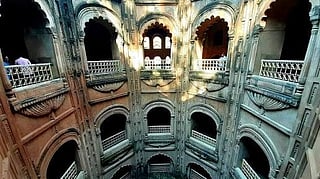
Ever heard that Lucknow has secret tunnels running beneath the city, connecting its grand monuments to places miles away? Sounds like something straight out of a movie, right? But ask around, and you'll find plenty of people who've heard this one too! That's the fun part about living in a city like Lucknow, where stories get passed around so often that it's hard to tell what's real and what's simply been made up along the way. So, let's put 11 such Lucknow myths and urban legends under the scanner and see which ones actually hold water!

Every Lucknow local has a cousin whose guide once walked into a Bara Imambara tunnel and came out in Delhi. Oddly, the guide never brought back a photograph. Or a Delhi address. This is how Lucknow does folklore, told with total confidence, passed along over chai, checked by nobody. So we checked. Haunted colonies, misjudged kings, gates named after the wrong poet, and a tunnel nobody can find. Some legends held up, some barely survived a quick search. Lucknow will forgive us, it has never let accuracy get in the way of a good story.
Nirala Nagar is a place where you worry about parking, not poltergeists. Locals disagree. The story goes that one colony sits on an old cremation ground, hence the knocks at night, the footsteps, the children crying. It shows up on every haunted-Lucknow list, in almost the same words. That's the first clue. Lists copy lists, and few seem to cite anything older than another list. Nobody seems to have produced the cremation ground either. The colony is reportedly from 1960, so the records, if they exist, are within reach. Ghosts are easy to find in listicles, archives are shyer.
The grand Rumi Darwaza, one of the city's most recognisable landmarks, is often assumed to be named after the famous Persian poet Jalaluddin Rumi. Sounds about right, doesn't it? Well, not quite! Built during Nawab Asaf-ud-Daula's reign, the 60-foot gateway actually gets its name from "Rûm", an old term associated with the Byzantine and Ottoman lands. So, this one's more about Turkish connections than poetry!
Wajid Ali Shah is often remembered as the Nawab who was too busy with poetry, music and dance to look after his kingdom. But was he really that bad a ruler, or is that just a version of history we've grown used to hearing? Much of this image comes from British accounts that painted him as incompetent to justify the annexation of Awadh in 1856. His reign, however, had more to it than royal indulgence, with administrative efforts and a lasting contribution to Lucknow's art and culture.
Not every Lucknow heritage story is a myth, and Chhatar Manzil proves it! While its name is commonly associated with the umbrella-shaped golden chhatris crowning its domes, another historical account links it to Chhatar Kunwar, mother of Nawab Saadat Ali Khan and wife of Nawab Shuja-ud-Daula. But here's another lesser-known bit: the palace's history is more complicated than its Nawabi identity suggests!
The Residency's walls are pockmarked with bullet holes, which tells you how it's remembered, not how it started. It was meant as an ambassador's home, begun around 1780 under Asaf-ud-Daula and finished by Saadat Ali Khan, for the British Resident at the Awadh court. The barricades came in May 1857, when Henry Lawrence began preparing for a siege. It's the wrong way round, really. A house built for diplomacy became the city's best-known battlefield, and visitors come to see the damage, not the dining room.
Lucknow's Ghanta Ghar is often sold as the city's Big Ben. It's an easy line, and tourism pages repeat it with confidence. What they rarely say is why it was built, to mark the arrival of a Lieutenant Governor, Sir George Couper, with money from the Husainabad Trust. Nobody asked London for a rematch. The tower is remembered for competing with Westminster because "the governor was visiting" doesn't make a postcard.
"1,024 ways in, only one way out." The line is delivered with perfect timing, usually just before the tip. The Bhool Bhulaiya is confusing enough to earn it. It has over a thousand corridors, hundreds of identical doors, and a roof that stays light because it's hollow. It doesn't need a secret map to disorient you. Guides do get paid to know their way around, and the legend does wonders for business.
La Martiniere is often called a school with a tomb in its basement, but the story actually began the other way around! French adventurer Claude Martin envisioned Constantia as a grand palace and his final resting place, with plans to turn it into a school after his death. He passed away before the building was completed, but his will ensured that his vision lived on. His tomb still lies beneath the school, with one story suggesting it was meant to protect the property from being seized by the Nawab, while another says it was part of the original architectural plan. Either way, Constantia has a rather unusual legacy!
Lucknow's Satkhanda is one of those monuments that comes with more than its fair share of mystery. Planned as a seven-storey tower, this unusual structure in the old city was left unfinished after only four floors were built. Over time, stories of curses and bad omens began doing the rounds, with some blaming the Nawab's injury, others pointing to his daughter's death, and a few even linking it to his own passing. But these tales don't quite agree with one another, making Satkhanda's unfinished story all the more intriguing.
If you've ever visited Lucknow's Picture Gallery, you might have heard that the Nawabs' portraits have eyes that seem to follow you around the room! It's one of those spooky little stories that visitors love sharing, adding a touch of mystery to the gallery's already fascinating collection. But before we give the portraits any supernatural powers, there's a simpler explanation worth exploring. From the way the paintings are created to the play of perspective and light, this curious legend might have more to do with art than anything paranormal!
To get all the latest content, download our mobile application. Available for both iOS & Android devices.