
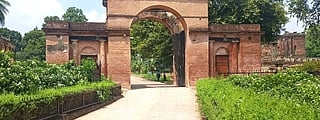
When someone says Lucknow ke darwaze, Rumi Darwaza is probably the first thing that pops into our heads. And fair enough, with its grand architecture and fascinating stories, it’s hard to miss! But the city’s history goes well beyond this famous gateway. Hidden in its old lanes and tucked into corners we often pass without a second glance are other darwazas that have seen Lucknow grow, change and make history. So, let’s step beyond Rumi Darwaza and know about 9 historic gateways of Lucknow.

Akbari Gate has welcomed emperors, caravans and, these days, a steady stream of e-rickshaws honking at nobody in particular. It was built in Akbar’s time as the door travellers from Agra knocked on before Lucknow let them in. Around it, whole neighbourhoods sprouted, Mahmud Nagar, Mansur Nagar, Ashrafabad. The market here sold toys, an oddly cheerful trade for an area whose nearby drain locals still call Sarkata Nala, the severed-head drain.
Asaf-ud-Daula raised Gol Darwaza around 1784, when Awadh was at its grandest, and royal processions and wedding parties passed through a clear road. Swaraj protesters gathered here decades later, and some left under arrest. The Nawab, reportedly, preferred flying kites nearby. Now Chowk has grown around it, up to it and nearly over it, and the arch holds its ground against encroachments and the winter makhan malai queue.
The Lakhi Gates are named after a price tag, which is a strange thing to be remembered for. Around 1850, Wajid Ali Shah had two identical gateways raised at Qaiserbagh, each reportedly costing a lakh rupees, a fortune then. They opened onto his idea of paradise, courtyards, gardens and the Parikhana. In 1856, crowds wept at the eastern gate as he left for exile in Calcutta. Then came 1857, when Begum Hazrat Mahal turned Qaiserbagh into a stronghold, and the British answered by demolishing most of it. The palace went, the gates, and their receipt, stayed.
Sher means tiger, and the gate wore it for decades before anyone thought to change it. Nawab Ghazi-ud-Din Haider had Sher Darwaza raised, reportedly as an inner entrance for the zenana. In 1857, Brigadier General James Neill, leading the relief column towards the Residency, was shot near it. The British answered by renaming it Neil’s Gate and putting up a monument. Later, independence cleared the monument, and masonry lions took the top of the arch. A gate named for a tiger, renamed for a general, and finally topped with lions.
The Baillie Guard Gate was built to keep a British Resident safe. In 1857, it became the most shot-at spot in Lucknow. Work began around 1780 under Asaf-ud-Daula and finished under Saadat Ali Khan II, and the name comes from Major John Baillie, the Resident whose guard of honour the Nawab arranged. Then came the siege. Cannon fire battered the gate, Captain Aitken won a Victoria Cross defending it, and the central arch was partly built up, leaving a narrow gap that Havelock and Outram’s relief forces squeezed through.
Lucknow’s darwazas were raised by nawabs and renamed by Britons. This one set out to be neither. Conceived in the 1990s under Mayawati as Dr. Bhimrao Ambedkar Udyan, it was meant as a counterweight to Nawabi and colonial architecture, with a gateway rooted in Buddhist design that reportedly echoes the toranas of Sanchi. Stone elephants greet visitors at the entrance instead of guarding against them. The complex took shape through the 2000s and was later renamed Dr. Bhimrao Ambedkar Samajik Parivartan Sthal.
Sir Harcourt Butler never owned Butler Palace, yet his name is the one on the gate. The Raja of Mahmudabad had the estate built in 1915 as Butler’s residence, and Butler laid the groundwork himself on 1 February. The Raja paid, and the Englishman got the signboard. After 1947, ownership slipped into legal disputes, and following the 1965 war the property was classified as enemy property over the family’s ties to Pakistan. Later it served as a sales tax office, a library and a guest house.
Sibtainabad Imambara survived a rebellion and a stint as a church. It was a lack of attention that brought down its gate. Amjad Ali Shah began it in the 1840s as his resting place and a hall for Muharram mourning, and his son Wajid Ali Shah completed it in 1847 after the king’s death. In 1857, British forces damaged its walls and gates on their march to Kaiserbagh, then used it as a temporary church until Christ Church opened in 1860. It was declared protected in 1919, while the main gateway collapsed on 2 April 2020.
The “small” imambara holds a mourning hall and two tombs under one roof, which is a lot for something called Chhota. Nawab Muhammad Ali Shah, the third King of Awadh, had it built in 1838 for Muharram mourning and Azadari. It was also meant to be his own final resting place, and his mother’s. The name only makes sense next to the Bada Imambara, its much larger neighbour, because the Hussainabad Imambara, as it is also called, was never modest in purpose.
To get all the latest content, download our mobile application. Available for both iOS & Android devices.