
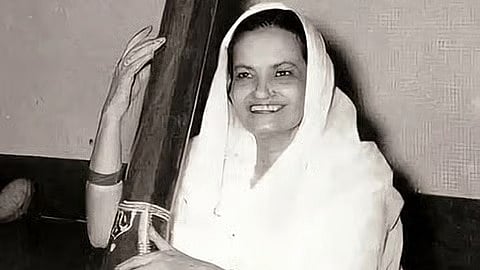
The life, music & legacy of Begum Akhtar, Lucknow's Queen of Ghazals
The era of Akhtari Bai Faizabadi, famously known as Begum Akhtar, began when she first performed at the age of just 14 and earned high praise from Sarojini Naidu. Born on 7th October 1914, Begum Akhtar mastered ghazal, thumri, and dadra from an early age, earning herself the legendary title of Mallika-e-Ghazal (Queen of Ghazals).
The versatility of Begum Akhtar

Though deeply inspired by classical stalwarts like Gauhar Jaan and Malka Jaan, Begum Akhtar grounded her artistry in pure classicism, choosing a repertoire rooted in complex raags.
With the advent of the talkie era, she ventured into cinema in the 1930s. The East India Film Company of Calcutta cast her in Ek Din Ka Badshah and Nal Damayanti in 1933. Later, renowned producer-director Mehboob Khan featured her in the 1942 classic Roti, composed by maestro Anil Biswas. Around 1937–38, after meeting Meher Baba, she began singing devotional Sufi ghazals and became a devoted follower. Eventually, she left the glamour of the film world behind to focus entirely on Indian classical music.
How pain, trauma, and depression fuelled her legacy?
She married Ishtiaq Ahmed Abbasi, a Lucknow-based barrister. However, owing to patriarchal customs and the social expectations of her husband's aristocratic family, she was restricted from practising music, performing on the radio, or singing in public.
This sudden five-year silence took a severe toll on her. Deprived of her art, isolated, and grieving the loss of her mother and multiple miscarriages, her mental and physical health deteriorated, eventually leading to severe depression. Recognising her worsening condition, doctors eventually warned Abbasi that returning to music was the only way she could recover. Accepting their advice, Abbasi supported her return to the stage. She made her historic comeback on All India Radio (AIR) in Lucknow, using her art as a path to recovery and resuming live performances.
Her voice demanded perfection, but her heart paid the price
Begum Akhtar was a relentless perfectionist. During a performance in Balaramapuram, near Thiruvananthapuram, in 1974, she felt that her singing had not met her own standards. Pushing herself to raise her pitch, the resulting physical and emotional strain caused her to fall critically ill, requiring immediate hospitalisation.
Shortly afterwards, during a visit to Ahmedabad at the invitation of her close friend Nilam Gamadia, she delivered what would be her final performance.
The story of Begum Akhtar's mazaar
Begum Akhtar was laid to rest in a peaceful mango orchard at her home in Lucknow's Pasand Bagh. Over the decades, as the area transformed into a densely populated neighbourhood, her grave fell into neglect. To save the Queen of Ghazals' resting place from obscurity, her admirers and local historians launched a major restoration drive around the 38th anniversary of her death, reviving the site and reaffirming her enduring place on Lucknow's historical map.
To get all the latest content, download our mobile application. Available for both iOS & Android devices.