
















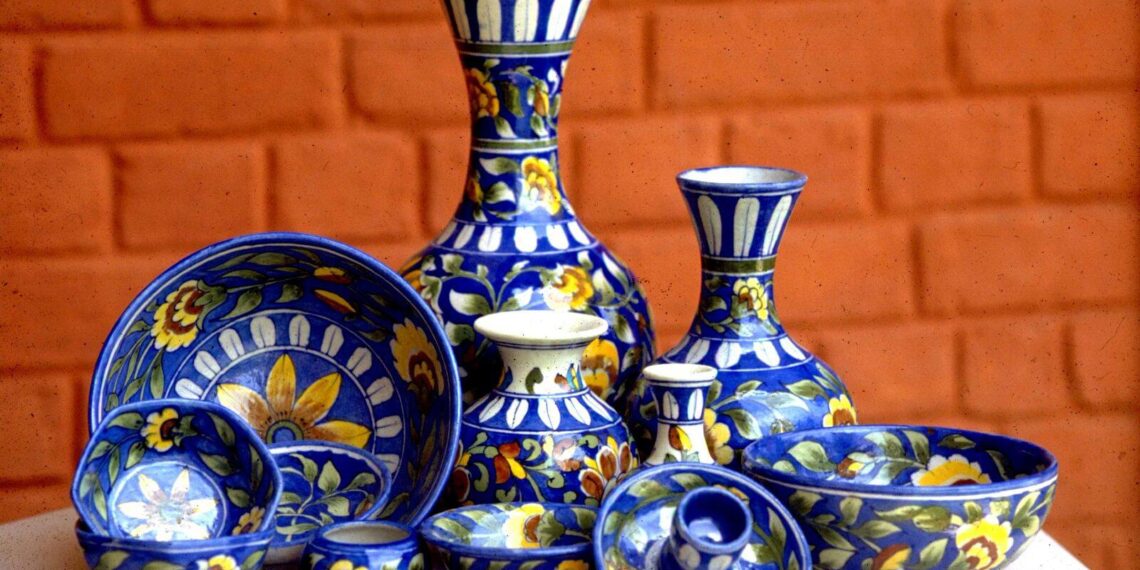
The royal town of Jaipur is lined by magnificent historical buildings that speak volumes of Rajasthan’s artistry. This creative finesse has also found its way to the artistic paraphernalia of the Blue Pottery artisans of Jaipur, who paint vibrant motifs on a blend of Egyptian paste and dough. Unlike clay pottery, this art form traces its origin to Mongolia and was brought to Jaipur in the early 19th-century. If these facts have intrigued you to chart the history and development of Jaipur’s Blue Pottery, then read on!
Journey to Jaipur, from a faraway land
During its early phases, the art of using blue glaze on pottery- a combination of Chinese technique with Persian designs, was used to make decorative tiles that adorned mosques, tombs and palaces in Central Asia. It travelled to Jaipur with the Turkish conquests of the early fourteenth century.
Post its arrival in India, Blue Pottery caught the attention of Mughal rulers and its technique grew beyond architectural accessory and into the domain of Indian potters. Finally, this technique travelled to Jaipur around the nineteenth century and the Pink City became a hub of Blue Pottery artisans.
No-clay pottery
Surprising but true, the production of Blue Pottery decor does not utilise even an iota of clay. Instead, artisans work basically on ground quartz and the difficulty in moulding this material makes the entire process time-consuming. Other raw materials used include- Fuller’s Earth, powdered glass, borax, gum and water.
The eye-grabbing blue of this pottery, after which it is named, owes its hues to cobalt-based dyes. Other colours such as- green, yellow and brown, are also used and they are sourced from the oxides of chromium, cadmium and iron, respectively. Further, once a Blue Pottery item has been made, it cannot be reworked.
Knock Knock
The exotic allure of Jaipur’s Blue Pottery is timeless, especially when combined with the majestic aura of the city. Like all crafts, Blue Pottery also needs the patronage of the masses to thrive, so next time you’re in the Pink City, don’t forget to stop by a pottery studio to purchase a few pieces that will perfectly adorn your mantlepiece.