





The morning cadence of Ahmedabad’s Old City begins with the sound of a wooden mallet. The air carries the scents of frying farsan, rosewood, leather, metal polish and aged varnish. Here, tucked into a narrow precinct lined with multi-storey pol houses, lies Dabgarwad Community Market in Ahmedabad, a specialised commercial enclave that has spent generations anchoring the musical and artisanal identity of the city.
In Dabgarwad, commerce is acoustic. A craftsman seated on a low wooden stool tests the tension of a tabla head (puri) with his thumb, listening for a pitch that only decades of muscle memory can recognise. A few feet away, stacks of unvarnished dholak shells wait alongside rows of brass-belled manjiras and black-rimmed khanjaris. Over time, much of Ahmedabad has expanded outward into high-rises and air-conditioned malls across the Sabarmati River, leaving behind this pocket of the Walled City, still operating with hand tools and generational knowledge
Origins and historical foundation
The Dabgars originally trace their lineage to regions of Rajasthan before migrating across western and northern India, including parts of present-day Uttar Pradesh and Gujarat. The community’s primary craft revolved around working with animal hides to create durable leather containers (kuppis) used to store oil, as well as gunpowder flasks, shields and saddlery. As industrial alternatives replaced raw-hide vessels during the nineteenth and early twentieth centuries, the community in Gujarat pivoted its material expertise towards percussion instruments. The technical knowledge required to treat, scrape, stretch and tune hide for drumheads drew directly upon centuries of leather-working expertise.
While popular belief links the market’s founding directly to 1411 CE, documented urban histories suggest that the concentration of musical-instrument shops near the Kalupur Swaminarayan Temple took shape during the late nineteenth and early twentieth centuries. The market’s proximity to the grand temple complex, established in 1822, was not accidental. Religious institutions, classical music academies, devotional gatherings (bhajans) and folk theatre groups generated demand for percussion instruments such as the pakhawaj, tabla and manjira, helping establish the surrounding area as a hub for musical-instrument makers and traders.
The anatomy of the craft
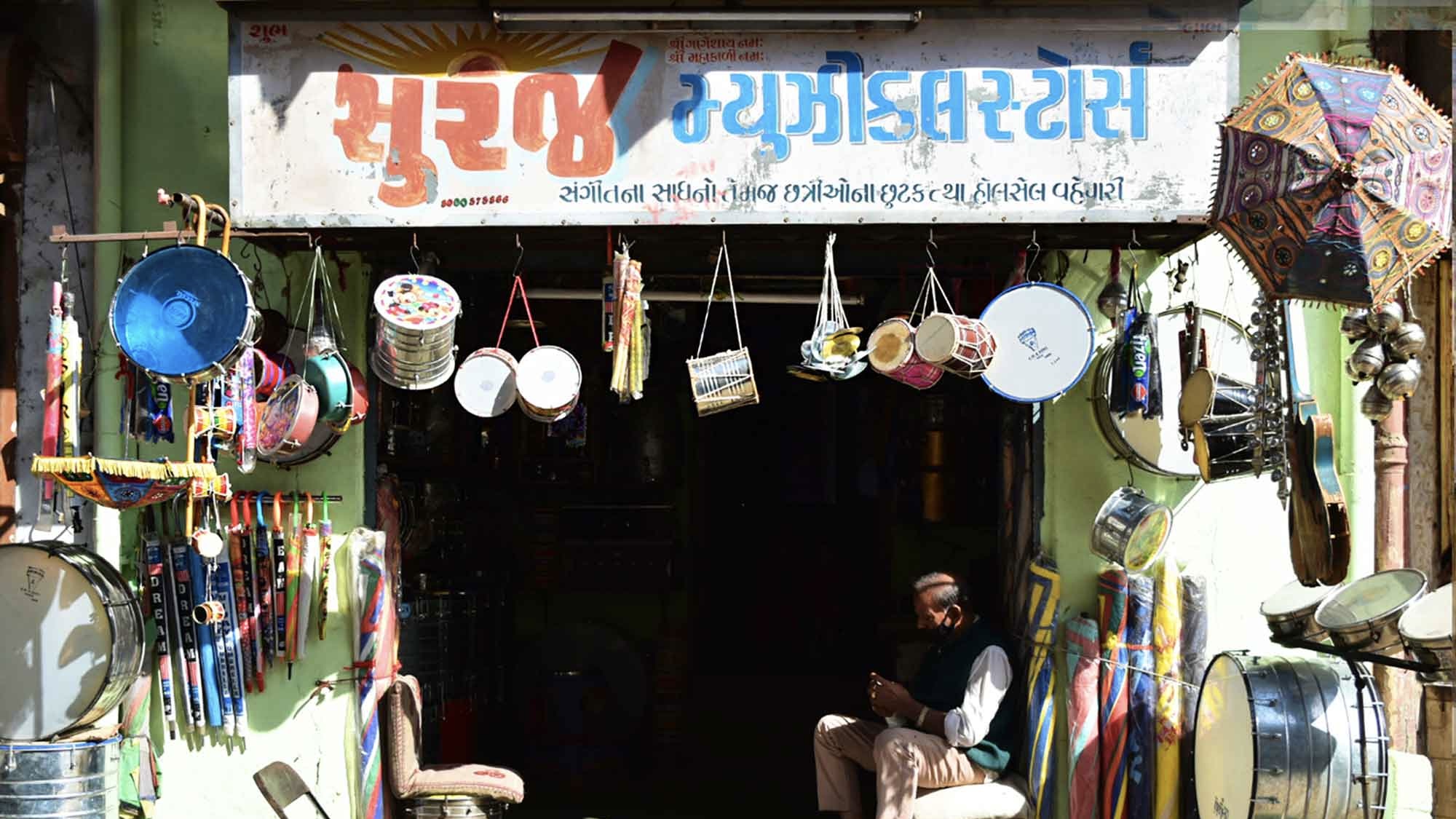
To understand the Dabgarwad market, one must understand the anatomy of a traditional Indian drum. The shops lining its narrow streets are part showroom, part repair workshop and part family archive. Most are modest spaces, only a few metres wide, with instruments spilling onto the raised front step (otla).
The primary instruments sold in Dabgarwad Ahmedabad include the tabla and dagga, the twin drums of classical music. They feature wooden shells made from neem or mahogany, paired with brass or copper components. The dhol and dholak are carved wooden drums used in folk dances and regional ceremonies. The pakhawaj is an ancient double-headed barrel drum associated with Dhrupad music and temple rituals. The market also sells percussion accessories such as handheld cymbals (manjiras), tambourine-like khanjaris and frame drums.
The defining craft knowledge of the Dabgars lies in creating the puri, or drumhead. Artisans source goat hide and scrape and cure it using herbal treatments and lime to achieve a uniform thickness. The black central circle on a tabla head is known as the syahi or gab. It is built up with multiple precise layers of a paste made from iron filings, soot and boiled rice starch. Tuning the drum depends on the precise weight and placement of this central patch. Even a fraction of a millimetre off-centre can alter the drum’s resonant overtones.
Adaptation in the age of amplifiers & umbrellas
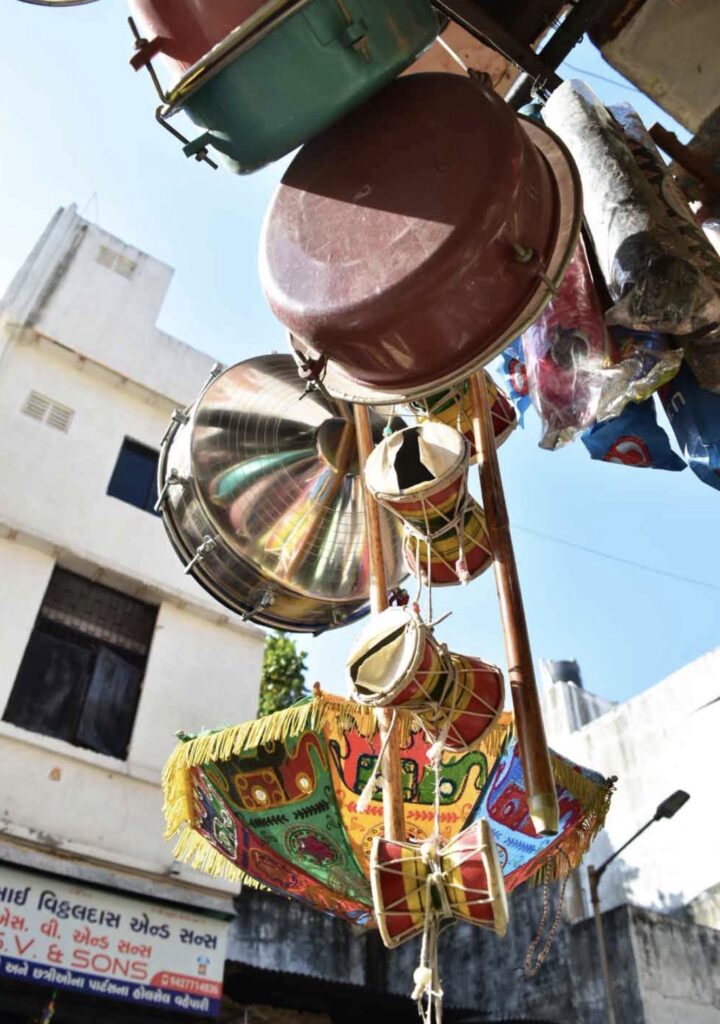
The survival of the musical instrument market in Ahmedabad has depended on pragmatic adaptation. Over the past four decades, changing electronic instruments have reshaped demand. The rise of digital synthesisers, electronic pad drums and mobile DJ setups impacted the market. Yet, the merchants of Dabgarwad diversified their inventory.
Today, the 40 to 45 active shops in the market present a study in commercial hybridity. On one side, artisans maintain their core craft through classical tablas, pakhawajs, folk dhols, dholaks, metal cymbals, hand-built khanjaris, and specialized hide restoration. On the other side, shopkeepers have adapted to modern demands by stocking nylon and canvas umbrellas, synthetic drum heads, plastic accessories, mechanical repair services, and seasonal festive props.
A visitor today will notice that nearly every music shop doubles as an umbrella store. This dual specialisation emerged as a clever hedge against seasonal dips in instrument sales. Framing, stitching and repairing umbrella canopies utilised skills similar to tensioning drum components.
Furthermore, during the weeks leading up to Navratri, Dabgarwad experiences a frantic resurgence. Orders for dhols and dholaks flood in from local garba troupes and wedding bands across Gujarat. During this window, workshops operate around the clock, tuning hundreds of drumheads to withstand nine nights of non-stop celebration.
Living heritage in a UNESCO City
When UNESCO declared the Historic City of Ahmadabad a World Heritage Site in 2017, it recognised the intangible cultural heritage embodied by its living markets.
As dusk falls over Kalupur, the streetlights in Dabgarwad illuminate shopfronts packed with polished wood and gleaming brass. A young student sits on an otla, testing a new dholak alongside an elderly master who makes a micro-adjustment to a wooden peg with a small copper hammer.
The Dabgarwad Community Market in Ahmedabad has survived centuries not by remaining frozen in time, but by adapting its methods while protecting its core knowledge. It stands as a testament to the enduring power of community-based craftsmanship, demonstrating how a traditional guild can maintain its identity inside a rapidly expanding modern metropolis.